Denny's Prolonged Financial Hardship
The Art of Racing in the RainDenny's prolonged financial hardship is the material pressure running beneath his legal struggle over Zoë: the costs and demands of the fight leave him with fewer choices at each turn. He sells the family home, moves with Enzo into a cramped apartment, and eventually cannot pay for ordinary necessities. The hardship is not presented as a single setback but as an accumulating loss of money, stability, and energy, with the custody conflict continually shaping what he can afford to do next.
Legal Conflict and Financial Pressure
Mark Fein tells Denny that, in his view, giving up his claim to Zoë could make the criminal charges disappear. He is careful in the narration to treat this as an inference, not an offer the opposing family has made outright. Mark bases it on what their lawyer said at the initial hearings: they did not want Denny jailed for the alleged offense, but wanted him registered as a sex offender, a status Mark says would prevent him from obtaining custody of his daughter. The distinction matters to Denny's finances as well as his legal position: the possibility of ending the charges is described as connected to surrendering the custody claim, not as a straightforward escape from expense or conflict.
The financial pressure becomes explicit when the narrator explains that Denny has no money left and that his opponents have, in effect, drained him. Mark threatens to stop working on Denny's defense, leaving Denny with little room to respond. The account links that depletion to the collapse of his household security and to the risk of losing legal representation. The economic strain therefore bears directly on his ability to keep contesting the case, while the terms Mark suspects the other side wants would make financial relief conditional on giving up Zoë.
The Sale and the Move
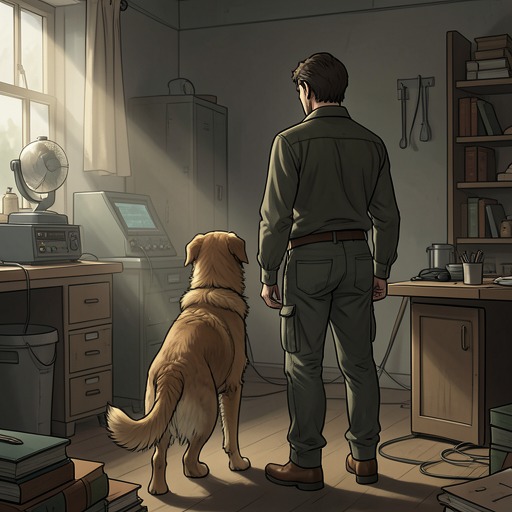
Denny sells the house and, one summer weekend, rents a truck from U-Haul and calls on friends to move the family's belongings from the Central District to a one-bedroom apartment on Capitol Hill. The move is a practical consequence of having no money left, but it also marks the loss of the home that had shaped Enzo's daily life. The old house had two bedrooms, one bathroom, a small yard, and a dog door Denny had installed so Enzo could go into the backyard. Enzo had a warm place on the living-room hardwood floor when winter sun came through the window, and could sit on the back porch on rainy days while Denny was at work.
The apartment offers a stark contrast. Its carpeting smells of chemicals, its insulated windows do not seem to breathe properly, and its refrigerator hums loudly; there is no cable television. These are the narrator's concrete measures of a reduced domestic life, not evidence of luxury being exchanged for a comparable home. What disappears is a familiar place and the small freedoms it allowed Enzo, while Denny's move to a smaller apartment makes visible how far the legal and financial pressure has reached into ordinary living arrangements.
Representation and New Demands
After Denny pays his account with Mark, Mark is appointed a circuit judge. Denny finds new counsel, Mr. Lawrence, who asks for a continuance so he can read the paperwork. The request delays the approaching reckoning and returns the case to a slow wait for the legal process to move. The narrative contrasts Mark's confident manner with Mr. Lawrence's subdued bearing, but the concrete consequence is that Denny must continue through proceedings after changing lawyers and waiting for the new representation to get up to speed.
Shortly after Mr. Lawrence begins representing him, The Twins sue Denny for child support. The suit adds a demand for money to the existing custody conflict: the same people seeking to take Zoë from him now also seek support payments. Mr. Lawrence describes the action as a legitimate, if ruthless, tactic and frames it as a case in which the opposing side appears to believe the end justifies the means. The evidence does not state the suit's outcome or the amount sought, but its arrival adds another financial demand while Denny's resources are already exhausted.
Depletion and Its Effects
The shortage reaches an immediate, public point when a card is declined. Denny stiffens and says that cannot be possible, a brief reaction that makes the abstract fact of his financial collapse suddenly concrete. Later, he tells Enzo that he cannot afford to care for him or even buy gas for his car, and that he has nothing left. His concern extends beyond his own needs: he names his inability to provide for Enzo as part of the crisis. Enzo can only look at him, unable to offer the reassurance he wishes he could express.
In the days and weeks after Denny's deflation, time loses its meaning for Enzo. Denny looks sickly and has no energy, and Enzo describes himself as sharing that lack of life force. They visit Mike and Tony, whose small house reflects a different financial position; Tony, Denny had once said, had been fortunate enough to be in the right place at the right time and would not need to worry about money again. At the kitchen table, Denny has tea and a manila folder before him while Mike paces nervously. The account leaves the folder's contents and the visit's result unspecified. It ends this stretch not with a financial recovery but with Denny still facing decisions and proceedings from a position of exhaustion and scarcity.